Webinar
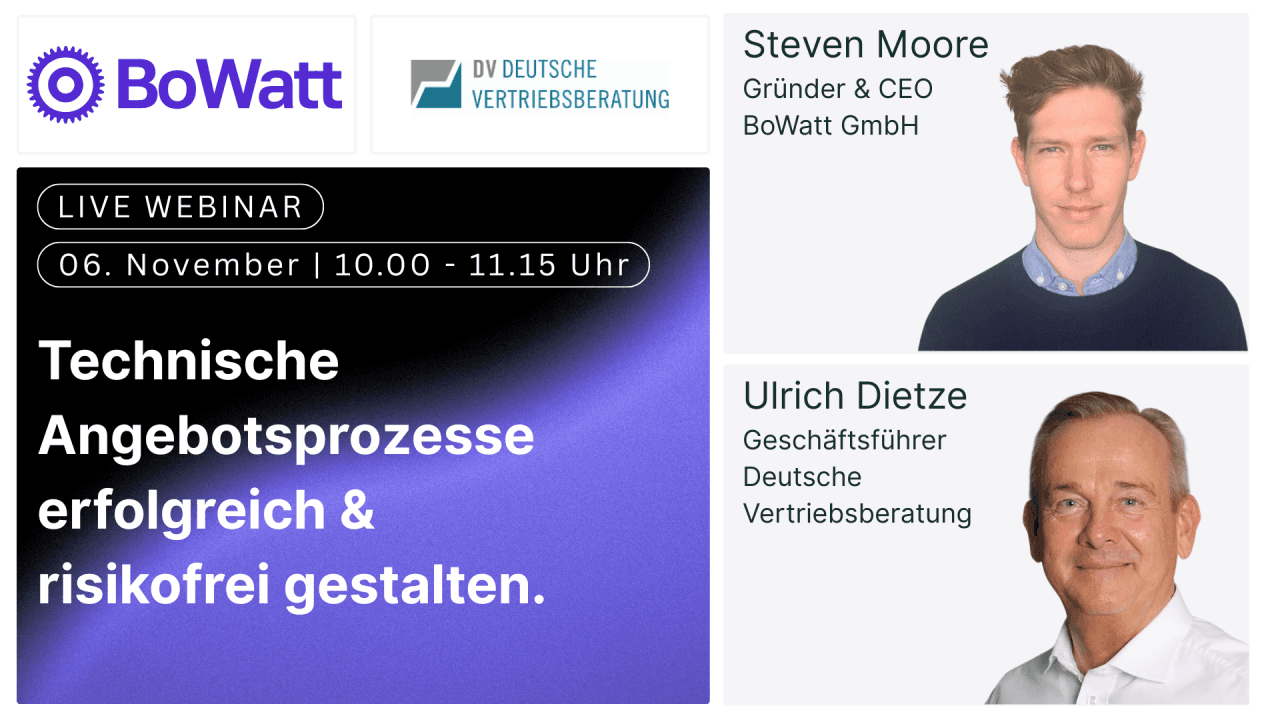
Webinar: How to Run Technical Quotation Processes Successfully and Without Risk

Steven Moore
https://www.linkedin.com/events/technischeangebotsprozesseerfol7381263472422113280/
For many industrial companies, the quotation process decides between profitable growth and costly mistakes. Weak pre-qualification and late risk detection often lead to reworks, customer conflicts, and margin losses.
In the webinar “Successful and Low-Risk Technical Quotation Processes”, Steven Moore (BoWatt) and Ulrich Dietze (Deutsche Vertriebsberatung) show why most problems arise before a quote is even written — and how the right mix of sales discipline and AI support helps avoid them.
Why technical quotations often become a risk trap
In many industrial companies, quotation processes have grown over years.
They are familiar and accepted.
That creates a false sense of safety.
The core problem is timing.
Key decisions are made even though critical information is missing.
Technical requirements are unclear.
Commercial assumptions are based on guesses.
The customer’s real intent to buy is not properly checked.
Still, quotes are prepared — under time pressure or because capacity is available.
Most risks stay hidden at this stage.
They appear later, after the order is placed in the form of changes, delays, margin losses, penalties, or customer conflicts.
Another issue is weak pre-qualification.
Many requests enter the quotation phase even though budget, decision process, or seriousness are unclear.
This leads to blind work and wasted engineering time.
On top of that, information is fragmented.
Emails, PDFs, Excel files, and meeting notes are scattered.
Important deviations or constraints are missed because no one has the full picture.
The result:
Quotation processes look busy and productive.
At the same time, they quietly build up risk.
When problems become visible, they are already expensive.
Key levers to reduce risk and protect margins
1. Strong sales before the quote
The biggest lever sits before the quote is created.
This is when customers are open and willing to talk.
The right questions clarify early:
Is the project real?
Who decides?
What is the timeline?
What really matters to the customer?
2. Clear minimum standards in sales
Successful teams work with clear standards.
Before a quote is prepared, key points must be known:
Project stage, decision date, budget or target price, decision makers, and next steps.
This reduces assumptions and avoids quotes built on shaky ground.
3. Smart AI support in the quotation phase
AI helps where manual work slows teams down.
Requirements are extracted automatically.
Risks and deviations are flagged early.
Internal alignment becomes easier.
This cuts effort, speeds up response times, and reduces costly errors.
Conclusion – From blind quoting to controlled growth
The webinar makes one thing clear:
Sustainable success in technical sales does not come from more quotes, but from better decisions made earlier.
When clean pre-qualification, clear standards, and AI-based risk analysis come together, quotation processes become faster, safer, and more profitable.
In this webinar, experts from BoWatt and Deutsche Vertriebsberatung show how technical sales teams can reduce risk, protect margins, and focus their resources on the right projects.
We’re hiring — click here to find our open positions