Webinar
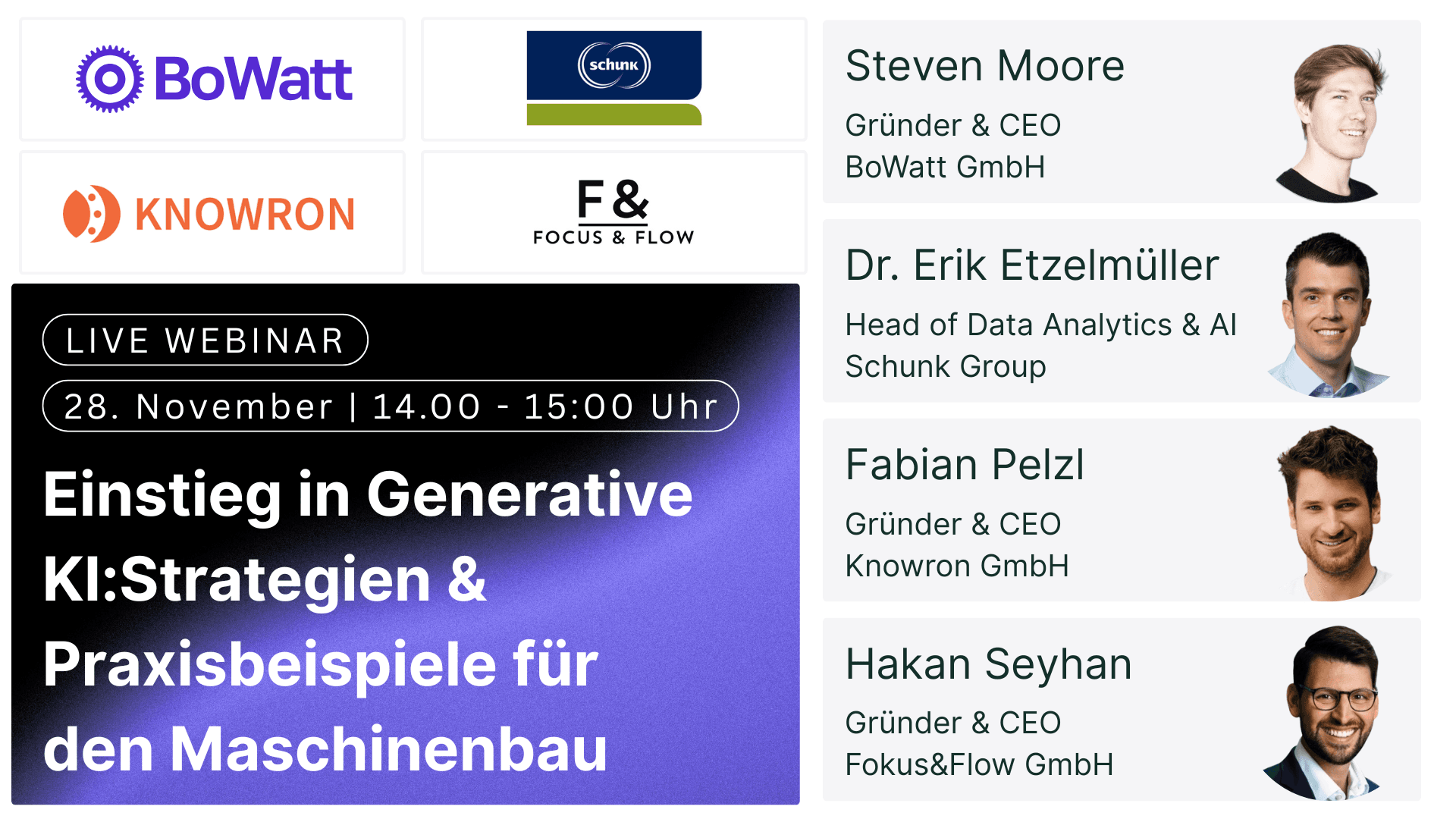
Webinar: Getting Started with Generative AI: Strategies and Practical Use Cases for Machine Builders

Steven Moore
https://www.linkedin.com/events/einstiegingenerativeki-strategi7260337967968276480/
Everyone in industry is talking about generative AI. Many teams test a tool, get excited for a moment — and then the momentum fades.
The reason is simple: pilots often stay “cool demos” and never turn into real improvements.
At the same time, real blockers show up fast: data protection, cybersecurity, legal rules. And the key question: what real business value does this bring?
In the webinar “Getting Started with Generative AI”, Steven Moore (BoWatt), Dr. Erik Etzelmüller (Schunk Group), Fabian Pelzl (Knowron), and Hakan Seyhan (Focus&Flow) talk about real use cases instead of hype.
They show concrete examples for white-collar and blue-collar work and share an enterprise view on how a large industrial company introduces AI in a structured way.
Three building blocks for a successful GenAI start
1) Leadership support — but not a CEO side project
AI must not be a top-down side project. It has to be owned by the teams who work with it every day.
Leaders create the conditions: time, clear priorities, training, and trust.
That’s how ideas turn into real improvements — not stuck pilots.
2) Basics first, then AI: standardize → digitize → automate → then AI
Many companies want to “AI-ify” processes right away. That almost always fails.
The better path:
First, create clear processes.
Then digitize them cleanly.
Automate where it makes sense.
Only then use AI.
3) Use case beats tool hype
There is no one tool for everything.
The starting point is always the concrete use case.
Then you choose the right tool.
One rule always applies:
AI in itself is not the goal.
If AI is the answer, the real problem must be clear: speed, cost, quality, collaboration, or service effort.
Practical examples — white collar and blue collar
White collar (technical sales / RFQ): BoWatt example
With the BoWatt module BoReq, technical specifications from PDF and Word documents are turned into structured requirements.
Requirements are assigned to departments and reviewed faster.
Deviations ( everything that is not standard) are detected.
This knowledge is stored and reused in future projects. That saves time, reduces errors, and speeds up quote reviews.
Blue collar (service & shopfloor): mobile workforce
The second use case focuses on service technicians and production teams.
The core problem: little time, high workload, and knowledge locked in people’s heads.
AI helps by:
giving fast access to verified instructions from company documents,
reducing downtime through faster troubleshooting,
creating service reports from voice input,
capturing expert knowledge directly in the work process and structuring it (with human review).
Enterprise perspective (Schunk): structured rollout
The enterprise view shows what it takes to make AI work at scale:
early alignment with legal and data constraints,
building internal understanding instead of outsourcing everything blindly,
running pilots to reduce risk,
and balancing build vs. buy based on effort and long-term operation.
Conclusion — from AI excitement to measurable results
This webinar makes one thing clear: successful AI adoption is not about trying ChatGPT once.
It is about:
choosing the right problems,
preparing processes and data,
and getting teams to implement.
Then generative AI can increase speed, cut manual work, secure know-how, and take pressure off overloaded teams — in the office and on the shopfloor.
We’re hiring — click here to find our open positions